
How Sushiro Conquered Singapore: A Masterclass in Blue Ocean Strategy and Operational Moats

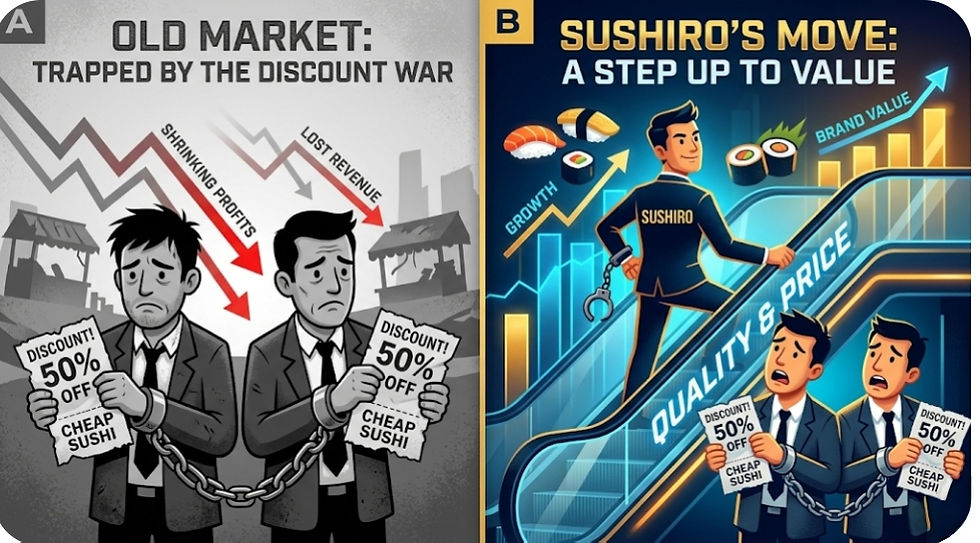
In Singapore’s saturated F&B landscape—where the sushi market alone is projected to hit USD 142 million by 2033—conveyor belt chains have historically fought a bloody "red ocean" war. For decades, incumbents like Sakae Sushi and Sushi Express competed solely on price or convenience, leading to stagnation.
Then came Sushiro in 2019. By applying Blue Ocean Strategy (creating new demand in an uncontested market space) rather than head-to-head rivalry, Sushiro rendered its competition irrelevant. Here is the strategic playbook behind its dominance.
1. Blue Ocean Strategy: Escaping the "Cheap vs. Premium" Trap
Traditional rivalry in Singapore fell into two camps:
· Cost leaders (Sushi Express): Low price ($1.50/plate), but perceived as low quality.
· Differentiators (Itacho, Genki): Higher quality, but significantly more expensive.
Sushiro created a new value curve. It simultaneously lowered costs (via technology and waste reduction) while raising perceived quality (Japanese rice, direct sourcing). This is the essence of Value Innovation—a core tenet of Blue Ocean Strategy. Customers no longer had to choose between "cheap" and "good." Sushiro offered both, removing the trade-off entirely.
2. Porter’s Five Forces: How Sushiro Weakened Every Threat
Applying Michael Porter’s framework reveals Sushiro’s defensive moat:
· Rivalry (High → Medium): By differentiating on tech and freshness, Sushiro moved away from direct price wars. Rivals like Sakae Sushi (stuck in the "red ocean") continued competing on coupons and loyalty points, eroding their margins. Sushiro competes on system efficiency, not discounts.
· Threat of Substitutes (Very High → Reduced): Alternatives (bento, ramen, hawker Japanese) remain threats. However, Sushiro’s "affordable premium" positioning and seasonal local menus (e.g., Cereal Sauce Shrimp Tempura) create a unique experiential substitute that is hard to replicate.
· Bargaining Power of Suppliers (Medium → Managed): Sushiro’s parent company (FOOD & LIFE) uses vertical integration and long-term contracts with Japanese fisheries. This secures raw material advantage—a classic Resource-Based View (RBV) strategy where rare, valuable supply chains become an inimitable asset.
· Bargaining Power of Buyers (Very High → Neutralized): Singaporeans are fickle and price-sensitive. Sushiro neutralizes this by offering high switching costs (not financial, but experiential). Once a diner experiences the RFID-based speed, strict freshness (350-meter rule), and app-based queue management, returning to a slower, less hygienic competitor feels like a downgrade.
· Threat of New Entrants (Medium → High Barrier): Any new brand can open a sushi shop. However, replicating Sushiro’s integrated tech system (RFID per plate, Digiro virtual belts, cloud IT) requires massive capital investment. This creates a technological moat that startups cannot easily cross.
3. The Resource-Based View (RBV): Tangible & Intangible Assets
Why can’t Sakae or Sushi Express simply copy Sushiro overnight? Because success is not just a strategy—it is a bundle of unique resources.
Resource Type Sushiro’s Asset Competitor Gap
Physical RFID-enabled plates & 350-meter disposal system Most rivals use visual checks or no automated disposal
Technological Digiro (virtual belt) & cloud-based global IT stack Sakae still uses legacy electronic ordering (retrofitted)
Human Strict hand-washing, Japanese rice training protocols Inconsistent execution across franchise outlets
Organizational Centralized global menu R&D with local adaptation Local chains lack global scale for seasonal campaigns
These assets are Valuable, Rare, Inimitable, and Organization-supported (VRIO) . Competitors cannot easily acquire them without years of investment.
4. Game Theory: The "Prisoner’s Dilemma" of the Conveyor Belt
In traditional conveyor belt sushi, if one competitor raises quality, others must follow or lose share. This led to a "prisoner’s dilemma" where everyone defected to lower costs, degrading the entire category. Sushiro broke this cycle by introducing a cooperative-escalation move: it raised quality and kept prices stable, forcing rivals to either bleed cash matching it or lose relevance.
Sakae Sushi attempted to follow with menu revamps, but without Sushiro’s underlying tech infrastructure, their costs rose faster than revenues. Sushi Express remains in the value segment but has lost the "upgrading" customer—the diner who now considers Sushiro the default option for a casual meal.
5. Strategic Expansion: The Experience Curve
Sushiro is exploiting the Experience Curve—the concept that cumulative production (or in this case, cumulative transactions) lowers costs over time. Each new outlet (now 16+) benefits from shared cloud data, supply chain logistics, and brand momentum. The Mandai Wildlife Reserve outlet (2025) introduced Digiro, a fully virtual belt. This removes physical conveyor belt costs entirely—something legacy chains cannot pivot to without scrapping their existing assets (a classic sunk cost trap).
Strategic Verdict: Why Sushiro Will Likely Stay on Top
From a Dynamic Capabilities perspective (Teece, 1997), Sushiro consistently senses and seizes new opportunities: post-COVID hygiene concerns (RFID), local flavor preferences (seasonal campaigns), and tourist demand (strategic outlets). Its competition suffers from strategic inertia—they are optimizing old models rather than reinventing them.
The business lesson for Singapore’s F&B landscape is clear: Do not compete on the same dimensions as everyone else. Create a new value curve, build un-copyable technological assets, and use data to constantly adapt. That is the Sushiro way.


