
The $83 Billion Question: Analyzing the Netflix-Warner Bros. Merger Through a Synergy Lens

How a streaming giant planned to rewrite media economics by acquiring a century of Hollywood IP.
In late 2025, the entertainment world was rocked by a proposed seismic shift: Netflix agreed to acquire the studio and streaming assets of Warner Bros. Discovery for approximately $82.7 billion . This would have placed HBO, DC Comics, Harry Potter, and a century of filmmaking history under the roof of the world’s largest streaming platform.
Although Netflix ultimately walked away from the deal in early 2026, citing an inflated price tag amid a bidding war with Paramount, the proposed transaction remains a masterclass in modern M&A synergy strategy . It perfectly illustrates the shift from the old media conglomerate model to the "scale-at-all-costs" streaming economy.
Here is an analysis of the strategic rationale, the financial engineering, and the regulatory hurdles that defined this near-miss merger.
1. The Strategic Rationale: From Renting to Owning
Historically, Netflix was a distributor. It rented content from studios like Warner Bros. to fill its library. The core synergy of this deal was vertical integration—Netflix sought to transform itself into a full-fledged studio owner .
Solving the "Licensing Cliff"
For years, Netflix has faced the risk that legacy media companies (Disney, Warner, NBCU) would pull their licensed content to feed their own platforms. By acquiring Warner Bros., Netflix would have permanently solved that problem, gaining control of a library that includes Friends, The Sopranos, and Game of Thrones .
Franchise Power
While Netflix is great at generating individual hits (Stranger Things, Squid Game), it lacks the deep, multi-decade franchises that drive merchandise sales and theme park attractions (which Disney excels at). The deal would have given Netflix DC Comics (Superman, Batman, Wonder Woman) and the Harry Potter universe—IP capable of sustaining films, series, and games for decades .
The "Halo" of HBO
Strategically, adding HBO to Netflix’s lineup was about prestige. Netflix offers volume; HBO offers curated, award-winning quality. Combining the two catalogs would have created a "super-bundle" with no gaps in the market—mass appeal plus critical darlings .
2. Financial Synergies: The $2 Billion Math
When analysts evaluate M&A, they look for cost savings (economies of scale) and revenue enhancements (cross-selling). Netflix projected massive results on both fronts.
Cost Synergies (Efficiency)
Netflix estimated it could achieve $2 to $3 billion in annual cost savings by the third year post-merger .
· Tech Stack Consolidation: HBO Max has long suffered from buggy technology. Netflix would have migrated all users to its superior, globally tested streaming infrastructure, eliminating Warner’s tech overhead .
· Marketing Efficiency: Combining ad sales teams and reducing redundant corporate functions in HR, finance, and administration.
Revenue Synergies (Pricing Power)
This is where the deal gets interesting for shareholders.
· The Bundle Arbitrage: Data suggested that 80% of HBO Max subscribers already paid for Netflix . Netflix planned to offer a "mid-tier" bundle including both services. While priced higher than the standard Netflix tier, it would be cheaper than paying for both separately. This lowers the consumer's effective cost while increasing Netflix’s Average Revenue Per User (ARPU) .
· The Ad Tier Boost: Netflix was building its advertising business. Adding HBO’s premium inventory would attract high-value brand advertisers, supercharging their ad-supported tier .
3. The Regulatory Nightmare (The Anti-Synergy)
Despite the financial logic, the deal faced a significant "anti-synergy": regulatory scrutiny. This was the primary reason Netflix eventually walked away, as the legal battles were projected to last 12-18 months or more .
Market Concentration
Critics, including Senator Elizabeth Warren, labeled it an "antitrust nightmare" . The combination of the #1 (Netflix) and #4 (HBO Max) streaming services in the US raised concerns about pricing power .
The "Broad Market" Defense
Netflix’s legal strategy was innovative. They argued the market is not just "subscription streaming" but total television—including YouTube, TikTok, and cable TV. In that context, their combined share of total viewing minutes was only about 10%, a much less threatening number . They argued they needed scale to compete with YouTube, not to monopolize TV.
The Theatrical Window
A major operational friction point was cinemas. Warner Bros. is a traditional studio reliant on theatrical box office. Netflix has historically despised theatrical windows, preferring to drop films directly online. To appease regulators and talent, Netflix promised a 45-day theatrical window—but Hollywood unions and directors like James Cameron remained skeptical, fearing the "death of cinema" .
4. Why the Deal Collapsed (Execution Risk)
Despite the synergy projections, Netflix backed away in February 2026. Paramount Skydance entered a bidding war, driving the price to a level Netflix deemed too risky .
Netflix Co-CEO Ted Sarandos stated the deal was a "nice to have" not a "must have" . The company recognized that integration risk was too high. Merging a data-driven tech culture (Netflix) with a legacy Hollywood creative culture (Warner Bros./HBO) is notoriously difficult. Disney’s struggles integrating Fox serve as a cautionary tale of culture clash destroying value.
Conclusion
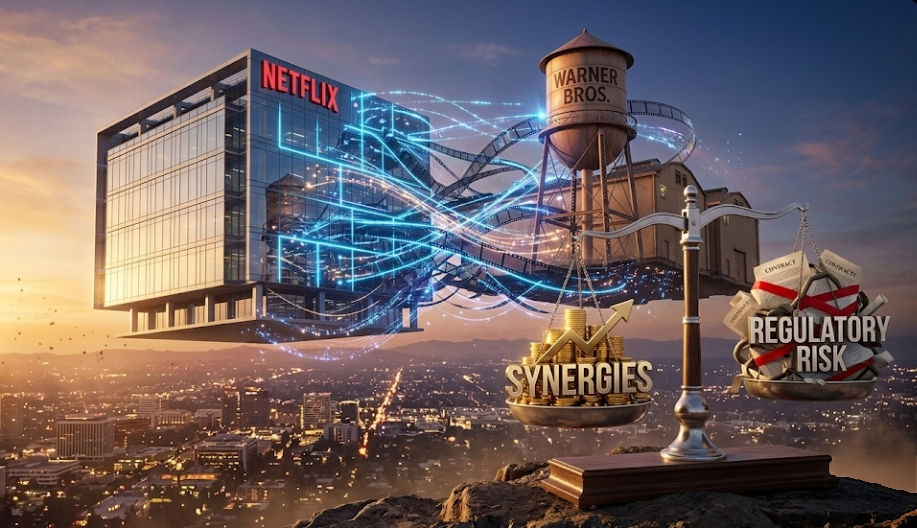
The failed Netflix-Warner Bros. merger is a perfect case study for business strategists. It highlights that synergy is a double-edged sword.
On one hand, the vertical integration of production (Warner) and distribution (Netflix) creates undeniable efficiency and a superior user experience. On the other, the "kingpin" risk—becoming so big that regulators and the public turn against you—creates a ceiling on growth.
Netflix decided that the math only worked at a specific price. When the price rose above that threshold (thanks to Paramount) and the regulatory headaches loomed, the $2-3 billion in synergies were no longer worth the headache. For now, Netflix remains a pure-play streamer, proving that sometimes the smartest synergy is knowing when to walk away.


